Showing posts with label Catholicism. Show all posts

Thursday, May 8, 2025

Habemus Papam: Pope Leo XIV

Habemus Papam. Robert Cardinal Prevost of the United States has been elected Pope Leo XIV.

https://i0.wp.com/newsverge.com/wp-content/uploads/2025/05/Pope-Leo-XIV.jpg?w=1200&ssl=1

Tuesday, December 9, 2014

Bill Murray... Trad?

Since this is Advent, I thought I'd share an excerpt from an interesting interview with actor Bill Murray.  Apparently, a practicing Catholic (his sister is a nun), he prefers the Extraordinary Form Mass and dislikes modern pop style liturgical music, preferring chant.

You don’t need to ask if his faith is important to him. He talks about how 19th-century candidates risk not getting canonised because the church is keen to push ahead with the likes of John Paul II and Mother Teresa. “I think they’re just trying to get current and hot,” he smiles.

One new saint he does approve of is Pope John XXIII (who died in 1963). “I’ll buy that one, he’s my guy; an extraordinary joyous Florentine who changed the order. I’m not sure all those changes were right. I tend to disagree with what they call the new mass. I think we lost something by losing the Latin. Now if you go to a Catholic mass even just in Harlem it can be in Spanish, it can be in Ethiopian, it can be in any number of languages. The shape of it, the pictures, are the same but the words aren’t the same.”

Isn’t it good for people to understand it? “I guess,” he says, shaking his head. “But there’s a vibration to those words. If you’ve been in the business long enough you know what they mean anyway. And I really miss the music – the power of it, y’know? Yikes! Sacred music has an affect on your brain.” Instead, he says, we get “folk songs … top 40 stuff … oh, brother….”

 Jimmy Fallon has also recently lamented how the Church establishment is attempting to make the Mass more pop-culture entertainment with social worker values, and less a religious sacremental worship.


Wednesday, March 13, 2013

Habemus Papam: Pope Francis

Habemus Papam.  Jorge Cardinal Bergoglio of Argentina was elected Pope Francis.

Wednesday, March 6, 2013

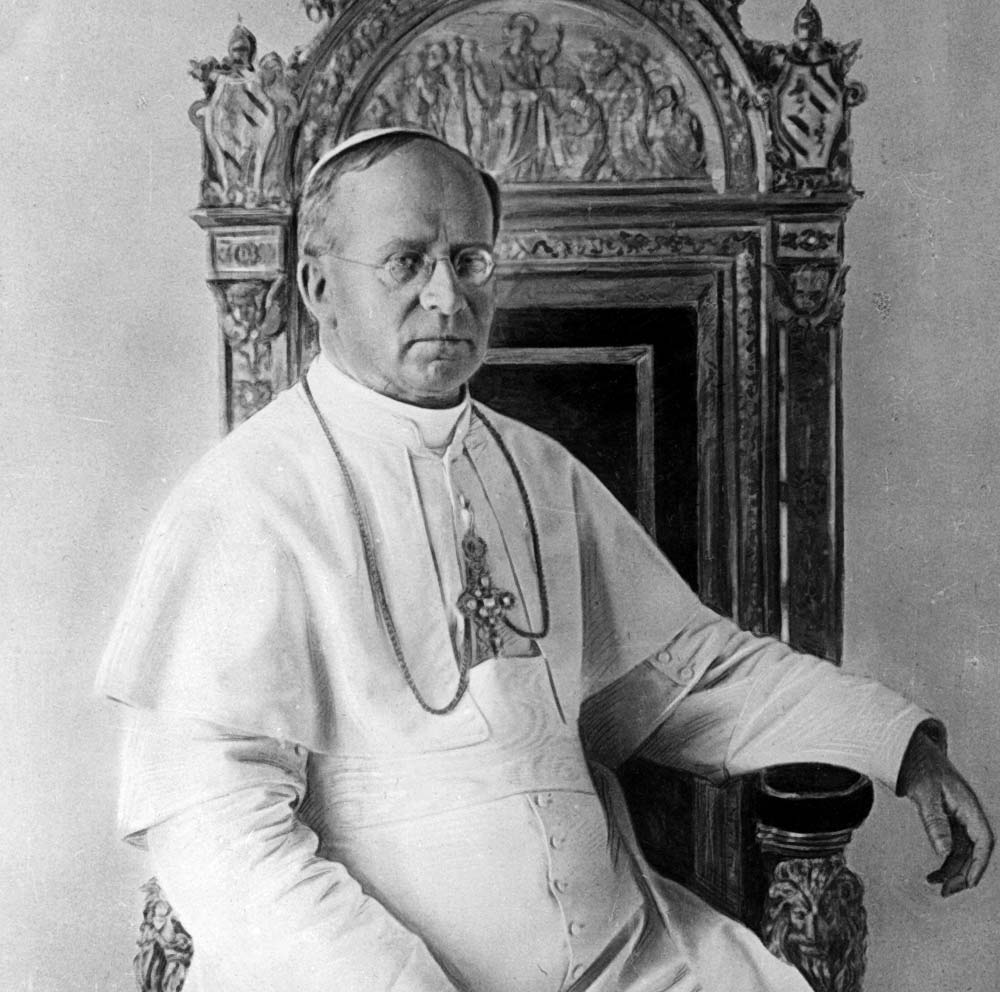
The Modern Era Popes


While we wait for the new pope to be elected, we should also take some time to appreciate the past. I find papal history fascinating.  Some of my favorites are the early modern popes, from the time photography was invented.

Pius IX (reigned 1846 to 1878) was the first pope to be photographed. He also changed the United States' status from a missionary territory, creating American dioceses and archdioceses.


Leo XIII (reigned 1879 to 1903) was the first pope to be filmed with a motion picture camera, and the first pope to have his voice recorded. He is also the oldest pope so far, living to be 93 years old. It's a shame his cause for canonization has not been advanced yet.


Pius X (reigned 1903 to 1914) is the most recent pope to be declared a saint. He is also the most recent pope known to perform miracles while he was alive (there are several documented cases where he healed crippled and dying children).  A very holy man.  We could use another pope like Pius X.


Benedict XV (reigned 1914 to  1922) had a noble and regal look to him.


Pius XI (reigned 1922 - 1939) was pope while America was going from the silent movie era to the Golden Age of Hollywood.


Pius XII (reigned 1939 to 1958) has been, over the last couple decades, slanderously vilified for being a Nazi sympathizer.  This is false, revisionist history as the facts show Pius XII did all he could to save Jews from the Holocaust (certainly more than Franklin Roosevelt ever did), and many Jewish leaders of the day, such as Golda Meir, praised Pius XII.


John XXIII (reigned 1958 to 1963) had a short pontificate, but lasting effects to this day.


Paul VI (reigned 1963 to 1978), with his Grinch-like eyebrows, had perhaps the worst pontificate of the 20th Century.  Under him, the Vatican II council went from discussing how the Church should deal with the modern world, to the Church submitting to the modern world. The Missal of John XXIII was replaced only a few years after being promulgated, for the casual and humanist centered Novus Ordo.  Priestly vocations dropped dramatically, while a vast number of clergy renounced their ministries.  The clergy sex abuse scandal and alleged cover up hit its peak during his pontificate.  Jesus Christ promised the gates of hell will never prevail against the Church, but it came awfully close during Paul VI's pontificate. His cause for sainthood should be put on indefinite hold.


John Paul I (reigned 1978) had one of the shortest pontificates in history. However I have very vivid memories of him, as his pontificate happened when I was a child.  I remember being quite sad when he died because I really liked him.


John Paul II (reigned 1978 to 2005) was the superstar pope.  He had the tough task of beginning the process of undoing all the damage caused during Paul VI's reign, while building his own legacy as the pope who traveled to the people.


And of course Benedict XVI (reigned 2005 to 2013), who is considered to be the most brilliant theologian of the last 300 years.

Wednesday, February 27, 2013

Pope Benedict XVI Abdicates

At 8PM Rome time on February 28, Pope Benedict XVI abdicated from the papacy. On his last full day as pope, Pope Benedict XVI delivered a personal and emotional farewell address to a cheering crowd, thanking the faithful around the world for their support and assuring them that he would remain in their service even in retirement. He also promised unconditional reverence and obedience to the next Pontiff.

Citing the weakness of old age preventing him from continuing on, speculation is that there is a more terminal health issue at the heart of the matter.  Regardless, I wish Pope Benedict XVI a happy retirement, and I thank him for his nearly eight year pontificate.  I thank him for beginning the process to restore Catholic tradition and culture, and taking the first steps to mend the rift with the Society of St Pius X, two things I hope the next pope will continue.  I thank him for releasing the Extraordinary Form of the Mass from its false banishment, and for beginning the process to reform and correct the Ordinary Form and the implementation of Vatican II.

I remember eight short years ago, watching on TV as the white smoke appeared. I had a gut feeling as early as the late 1990s Cardinal Ratzinger would be the next pope after John Paul II.  As soon as Cardinal Medina announced "Joseph", and before he could say "Ratzinger", I knew.

Dominus vobiscum, Benedictus.

Sunday, December 2, 2012

Reformed Roman Missal- One Year Later

Well, its been a whole year since the new English translation of the Roman Missal has been promulgated.  I can neither say it has been a success nor a failure. The rebellion against the translation the critics on the left were hoping for never happened.  The vast majority accepted the new English words with nary a kick or a scream.  Yet, there hasn't been a fundamental change in the way Mass is celebrated in the typical parish, either.  Despite the new words, there are still the stripped down sanctuaries, with tiny wood altars that look like dining room tables.  There is still the hand holding, the banal Broadway show tune Mass Settings and adult contemporary hymns that celebrate people while ignoring all things mystical and spiritual.  In the typical parish, mine included, Mass is still a liturgical Woodstock wannabe. I don't listen to Broadway show tunes.  Why in the world would I want to go to Church and hear Mass settings in a Broadway style? What I have come to realize is that the problem is in the rubrics, or more accurately the lack of rubrics, in the Ordinary Form (rubrics are the actions that go along with the words, such as kneeling, facing ad orientum, how often the priest makes the sign of the cross, etc... think of it as choreography).  The Ordinary Form, aka Novus Ordo, was fabricated by Annibale Bugnini, and was to be a simplified form.  It has so few rubrics, it allows priests to celebrate, or rather "preside" (as the Novus Ordo rubrics call it) Mass in their own individual styles, and sadly, many adopted a hippie social worker style that seems to be eternally stuck in the early 1970s.

I find myself agreeing with comedian Jimmy Fallon, who expressed his thoughts on the Catholic Mass in this interview with NPR.  On the traditional Mass, he said,
"I just, I loved the church. I loved the idea of it. I loved the smell of the incense. I loved the feeling you get when you left church. I loved like how this priest can make people feel this good. I just thought it was, I loved the whole idea of it. My grandfather was very religious, so I used to go to mass with him at like 6:45 in the morning serve mass and then you made money too if you did weddings and funerals. They'd give you, you'd get like five bucks. And so I go okay, I can make money too. I go this could be a good deal for me. I thought I had the calling. "

But on the way Mass has gone since the Novus Ordo was implemented, he said,
"I don't go to - I tried to go back. When I was out in L.A. and I was like kind of struggling for a bit I went to church for a while, but it's kind of, it's gotten gigantic now for me. It's like too, there's a band. There's a band there now and you got to, you have to hold hands with people through the whole mass now, and I don't like doing that. You know, I mean it used to be the shaking hands piece was the only time you touched each other. Now I'm holding, now I'm lifting people. Like Simba. I'm holding them, ha nah hey nah ho.  I'm doing too much. I don't want - there's Frisbees being thrown, there's beach balls going around, people waving lighters, and I go this is too much for me. I want the old way. I want to hang out with the, you know, with the nuns, you know, that was my favorite type of mass, and the Grotto and just like straight up, just mass-mass."

I find myself having similar thoughts.  My own parish has the casual, Broadway-Woodstock style Mass, that I find increasing difficult to sit through.  I want tradition.  I want to hear chant. I want some Latin. I want to hear bells and smell incense.  I want the priest to be a spiritual leader, leading us in prayer and sermonizing about faith and miracles, not a performer who tries to entertain us, while making social justice his only message.  There is another parish in my neighborhood that has a more traditional Mass, with bells, incense, chant, and even some Latin.  They even have the Extraordinary Form (aka Tridentine Latin Mass) every week.  Can I bring myself to quit my parish and join this other one?  In time, I may not have a choice, if going to Mass at my parish continues to be like a chore or a penance to suffer through.

If I had the Pope's ear, I would humbly suggest to him that the Order of the Mass for the Ordinary Form needs to be reformed.  The 1965 Order should be restored to the Ordinary Form Roman Missal, replacing the Annibale Bugnini fabricated Order.  The 1965 Order of the Mass was, essentially, a vernacular translation of the Tridentine Latin Order, slightly simplified in rubrics, with some repetition removed, thus making it fulfill Vatican II's requirements- - in fact, the 1965 Missal was heralded "The Mass Of Vatican II".

Saturday, November 26, 2011

Reform of the Roman Missal

We have said goodbye to the inaccurate, paraphrased English translation of the Roman Missal of the Ordinary Form. This weekend the new and improved, and more accurate English translation was implemented. The words match the Latin, and are more poetic and inspirational.  The downside is that many parishes, including my own, are still using sugary, folk-pop style "Liturgical music".  Hopefully, in time, that will change as new composers become inspired, and parish music directors become less fearful of using Gregorian chant.

I attended the 5pm vigil mass at my parish. The new words were very beautiful and inspiring... but the overall anticipation for this event let me down a little. I was looking forward to saying the Confiteor, with the "mea culpa", but we skipped over it and went right to the Kyrie.  Although I don't blame him, the priest didn't seem well rehearsed with the new words and stammered quite a bit. And there was the Andrew Lloyd Webber hymnal that bogged the celebration down.  One nice thing was when the parish said "And with your spirit" the very first time, very loud and confident.

But overall, I hope in the weeks to come, the priests will get more used to the new words, and not stumble so much, and we may get better music... perhaps even chant.  And hopefully we will get to say the Confiteor soon.

There are critics on the left who say the older 1970 paraphrase translation is more understandable, and there are critics on the right who say it doesn't matter how they improve the translation because only the Extraordinary Form of the Mass is pleasing to God.  While I am fond of the Extraordinary Form (the 1962 Missal of Blessed John XXIII), I don't know if simply going back to it exclusively is something that would be accepted by the ordinary Catholic, unless it is gradually done over a generation.  Even I don't think I could attend the Extraordinary Form exclusively, due to the somewhat confusing nature of it, not so much  due to the Latin, but because much of it spoken by the priest in a low voice, having the people sit there in silence, reading the English translation missalettes on their own. The plan of Pope Benedict XVI seems to be to gradually merge the Novus Ordo of Paul VI and the 1962 Missal of Blessed John XXIII together. The new English translation of the Missal of Paul VI seems to be step 1. Some years later, step 2 may be a hybrid Mass, perhaps based on the 1965 Missal. After a decade or so of that, then it would be feasible to think the 1962 Missal could be restored as the only form, slightly revised to include more vernacular, less "sotto voce", and to fit the newer liturgical calendar and three year cycle of readings.

But for now, I am looking forward to the new English translation of the Ordinary Form, and excited to see the celebration of it become better and more fluid, and just maybe, priests may start saying the Eucharistic Prayer ad orientem.

Sunday, March 20, 2011

Review: Ronald Knox Bible

With Lent here, I thought this would be a good time to review the Ronald Knox version of the Bible. A few months ago, I was lucky enough to win a used copy from the Catholic Bibles blog. Obviously, I haven't read the entire Bible, but I think I've read enough to give a review.

First, a little history. Initially, the main Catholic English translation of the Bible was the Douay-Rheims, which I wrote about in a previous post. In the late 1930s-early 1940s, revisions began on the Douay-Rheims, but this time, America and Britain would work on their own translations. In America, there was the Confraternity New Testament, which I also discussed in that same post. In Britain, Monsignor Ronald Knox took it upon himself to revise the entire Bible, and the result is what is today referred to as the Knox Bible.

There are those who say the Jerusalem Bible is the most poetic and lyrical modern translation of the Bible. In my opinion, the JB reads more like a novel, and the title of most poetic and lyrical modern translation should go to the Knox Bible. With its British flavor, it does have a very melodic cadence. As with the Confraternity New Testament and the Revised Standard Version: Catholic Edition, the Knox Bible has mild archaic language, making the passages sound more prayerful without getting so archaic as to think one is reading Shakespeare. Regarding the Psalms, Fr Knox has done something I think is clever. In the original Hebrew texts, certain Psalms are written so each verse begins with a letter of the Hebrew alphabet, going in order. Knox translated these Psalms in such a way to do the same thing with the English alphabet.

There are certain passages that a Catholic always looks to first to see if that Bible has the traditional translation. The Knox Bible scored high in that regard.

Genesis 3:15-16 "And I will establish a feud between thee and the woman, between thy offspring and hers; she is to crush thy head while thou dost lie in ambush at her heels."

Matthew 16:18 "... thou art Peter, and it is upon this rock that I will build my church; and the gates of hell shall not prevail against it."

Matthew 16:26 "How is a man better for it, if he gains the whole world at the cost of losing his own soul? For a man's soul, what price can be high enough?"

Luke 1:28 "Into her presence the angel came, and said, Hail thou who art full of grace; the Lord is with thee; blessed art thou among women."

John 3:16 "God so loved the world, that he gave up his only-begotten Son..."

Unfortunately, the Knox Bible also misses some. In the Gospels, "amen I say to you" is not used. The classic phrase "In the beginning" is changed to "At the beginning of time" in both Genesis and John. The much loved Psalm 23 is a little clunky (the King James version of Psalm 23 seems to be the definitive standard). Luke 1:34 has Mary asking "How can this be" (implying she doubts the Angel Gabriel) instead of "shall" or "will". Isiah 7:14 has "maid" instead of "virgin".

But overall, I enjoy this version, and would not hesitate to recommend it.

Wednesday, December 1, 2010

Scripture and Liturgy

Since we are in Advent, I thought I'd do a post relevant to the season.

The New English translation of the Roman Missal

There are two forms of the Mass in the Roman rite of the Catholic Church. The Extraordinary Form of the Mass (sometimes referred to as the "Tridentine Mass") is the ancient and reverent form, where mostly Latin is used, and the priest celebrates it ad Orientum ("to the east"), facing the same direction as the people, as he is leading them in prayer. This form is very beautiful and spiritually uplifting, especially when the priest sings and chants the entire Mass. Unfortunately, since the 1970s, many bishops, in complete error, suppressed and even forbid the celebration of the Extraordinary Form. Thankfully, our wonderful current Pope, Benedict XVI, issued a statement a few years ago that cleared up the status of the Extraordinary Form, proclaiming it is and always had been valid, and every Catholic has the right to participate in this form of the Mass if they want to. It is now making a strong comeback, especially among young adults.

The second is the Ordinary Form (also known as the "Novus Ordo"). It is an abbreviated form compared to the Extraordinary, and has more options, such as celebrating it in the vernacular, allowing lay people to read the scripture readings and to distribute the Eucharist, and letting girls serve as Altar Servers. This form is more casual, and the focus is more on community than on spirituality.

The main problem is that the English translation of this form was done in a hurried and haphazardly fashion, resulting in the English translation being more of a paraphrasing of the Latin source text in very casual, conversational English. The Vatican wisely found this to be inferior, and requested the Roman Missal be re-translated into English in a more faithful way. After a decade, it is finally completed and approved, and will begin to be implemented over the next year.

Having had a chance to read the new translation on the USCCB website, it is a great improvement over the current translation. It corrects many of the flaws, and uses a higher form of English more worthy of the Mass. It also revives a sense of spirituality that the old translation lacked. I am definitely happy with this, and excited for when it replaces the old translation. My only hope is that we also get some new Liturgical music that is more worthy of Mass than the bland "Kingston Trio" style pseudo-folk sing-a-longs we currently have to suffer through in the Ordinary Form. If there are any parish music directors reading, please trust me: chant is your friend. And throw the pan flutes in the garbage.

Oddly, there is a small, yet obnoxiously loud, group of people (mostly far-left extremists... you know, the kind who think felt banners and cloth streamers are more beautiful than traditional statues and icons, and believe holding hands during the Our Father is more important than to recieve the Body of Christ while kneeling) who are against the new translation. These people would prefer all spirituality be removed from the Catholic faith, leaving it little more than a social justice organization.

English Bible Translations

There are several different English translations of the Holy Bible. I will give a quick review of the main Catholic versions.

The Douay Rheims is the traditional Catholic Bible, in use for over 500 years. It is a literal translation of the Latin Vulgate, the official Bible of the Catholic Church for 1500 years. It is accurate and completely free of doctrinal errors. It is in "Shakespearean" English and was revised in the mid-1700s by Bishop Richard Challoner. I use this Bible for serious prayer and devotional reading. In the U.S. in the 1940s, a revision of the New Testament was published by the Confraternity of Christian Doctrine. This "Confraternity Version", as it became known as, removed much of the archaic language and fine tuned the overall translation. In my humble opinion, it is one of the best versions of the New Testament. It is still available from a few publishers in a pocket book format. Unfortunately, the Old Testament was never revised.


The New American Bible is a modern English version that is translated from original language texts, including the Dead Sea Scrolls. Work on the Confraternity Version Old Testament was abandoned to work on the NAB instead. In the U.S., Scripture readings in Liturgy are taken from a slightly altered version of the NAB. This is the only modern translation of the Bible to use the phrase "Amen I say to you" spoken by Jesus in the Gospels, instead of the more common "truly I say to you". A Revised Edition of the NAB is due to be published in a year or two. I hope the new edition will include the altered version of the New Testament that is used in Liturgy (and is very similar to the Confraternity New Testament). Although this version has some critics, I like it, and I use it for more casual reading. (UPDATE: The New American Bible Revised Edition will be published on Ash Wednesday. The Old Testament has been fully revised, and the excerpts I have read seem very good.  The Psalms have also been completely revised, and are much better than the 1992 revision which was riddled with inclusive language and banal word choices.  Unfortunately, the New Testament was not revised at all, so the Liturgical changes, such as the restoration of "Hail full of grace", will not be included.)


The Jerusalem Bible was published in 1966, and in English speaking countries outside of the U.S., it is used in Liturgy (although that is starting to change). J.R.R. Tolkein worked on the Jerusalem Bible. It is hard to find in the U.S., but I have an old paperback copy I found at a used bookstore. I like it, but to me, it reads more like a novel than Scripture (which can be both an advantage and a disadvantage). A revision, "The New Jerusalem Bible", which is not approved for use in Mass due to the use of inclusive language which changes the meaning of some Scripture passages, has been the most popular Catholic Bible in the English speaking world outside the U.S. The revision is said to be a more literal translation than the original Jerusalem Bible. In the Old Testament, both versions use the name of God "Yahweh" in place of "the Lord". There is one particular translation choice I do not care for. In Matthew 16:18, where it traditionally reads "you are Peter and on this rock I will build my church...", the New Jerusalem Bible uses "community" in place of "church".

The Revised Standard Version: Catholic Edition is a revision of the King James Bible and places the Duetercanonical books in proper Catholic order. Since it is a revision of the King James, this is the best Bible for converts to the Catholic faith, and is very useful to those who are apologists or who have dialogue with protestants. Many modern Catholic theologians and conservative Catholics prefer this version (its rabid fans can be called "RSV-onlyists"), and it is used in the English translations of the Vatican's documents (including The Catechism of The Catholic Church) and the Pope's encyclicals, a concept that could be traced back to the booklet The Catholic Religion Proved By The Protestant Bible. However, there are many who say, due to the RSV:CE's protestant origins, the choice of words used in the translation, while being technically correct, lack doctrinal certainty. In addition to the original RSV:CE, there is the "Revised Standard Version: Second Catholic Edition" which removes the archaic "thees" and "thous" the RSV:CE has, and makes some minor translation improvements, there is the "Oxford University Press RSV:CE", which is a hybrid of the original RSV:CE and the 1971 RSV protestant revision, and there is "The New Revised Standard Version: Catholic Edition", which, like the New Jerusalem Bible but to a greater degree, uses inclusive language which changes the meaning of many Scripture passages. Sadly, the Bishops of English speaking countries, such as Canada and the U.K. are choosing to replace the Jerusalem Bible in Liturgy with the New Revised Standard Version, despite it's many flaws and the Vatican initially not allowing it for use at Mass. In my humble opinion, either the Revised Standard Version: Second Catholic Edition or even the New Jerusalem Bible would be a better choice.